Monday, October 13, 2014

Reinventing Organizations

A talk and Q&A by fellow McKinsey alumnus Frederic Laloux about his book "Reinventing Organizations".  He lays out the 3 key breakthroughs of the next generation of organizations:

  1. Self-management
  2. Wholeness (I would call it Authenticity)
  3. Evolutionary Purpose

I would say the Bossless Organization is very strong on #1, and definitely compatible with #2 and #3.  It's a long video, but well worth watching.  I've started on the book too, and it is definitely a must-read.

Tuesday, November 20, 2012

When No Boss Is The Best Boss

I'm quoted quite a bit on the concept of the Bossless Organization in this article by Mary Jander, the Managing Editor over at Internet Evolution.  Surprisingly active comments too.  I think the concept really engages people.

"When No Boss Is The Best Boss"

Monday, June 25, 2012

Self-Management wins M-Prize

Self-management was a big winner in the newest round of Harvard Business Review/McKinsey Management Innovation Prizes, with The Morning Star Company winning the Management Innovator of the Year award and Paul Green Jr. winning for "The Colleague Letter of Understanding: Replacing Jobs with Commitments".
Morning Star is one of the world’s leading processors of tomatoes—and one of the most progressive models of a self-managed enterprise we’ve seen. The company was founded in 1970 with a distinct philosophy: people are most productive, creative and happy when they have personal control over their own lives. And the best organizations are those in which people are not managed by directive from above but when coordination happens among peers who manage their own relationships and commitments. In the last 30 years, founder Chris Rufer and his colleagues have built a company to bring that philosophy to life: no bosses, no titles, not job descriptions, and a sweeping scope of authority for every individual. ... At the heart of this peer-regulated collection of colleagues who determine their own roles and responsibilities is the “Colleague Letter of Understanding” or CLOU. Four years ago, the company introduced a custom social network to support a more dynamic, transparent, and scalable approach to self-management. Today, an ever-evolving (and immediately visible) network serves as “org chart” and peer-to-peer responsiveness replaces hierarchical control.
If you'd like to learn more, check out the Self-Management Institute.

Sunday, June 24, 2012

Does power corrupt?

Science says yes.  Another strong reason for the Bossless Organization...

Wednesday, June 20, 2012

WSJ discusses bossless organizations!

And it's one of their most emailed stories, so it clearly struck an interest with readers.  Try this link or this one to read the whole story.

Wednesday, November 16, 2011

TED talk on the Bossless Organization

Back in June I had the opportunity to speak at TEDx Houston on the University of Houston campus.  It was a fantastic experience I really enjoyed.  Well, the professionally edited video of my talk is finally available: "What is Social Systems Architecture and why does it matter?"  It covers kind of a wide range of topics over 20 minutes, including material from my other blog, Houston Strategies:
  1. The Opportunity Urbanism philosophy of cities and how Houston is an exemplar of that model
  2. Branding Houston
  3. A transportation/transit solution for decentralized cities (like Houston)
  4. Organization 2.0 and the Bossless Organization model
  5. Reforming K-12 education with empowerment
As a reader of this blog, #4 is probably what you're interested in, and that starts at the 13:37 point if you want to jump ahead.

And yes, if you're wondering, I broke all the TED talk rules by packing way too much into my 20 minutes (and apologies in advance for the frequent throat clearing; lesson learned: no ice water before speaking).  But I got some very positive feedback from the audience, so at least some people appreciated the difference from the usual TED talk model.  The video does a decent job of capturing the slides too (use the bottom right-side arrows to make it full screen), but you can also download a pdf of the slides here.

Enjoy.  As always, thoughts and feedback are welcome in the comments.

Saturday, September 17, 2011

The Human Project

A couple friends of mine (and fellow M-Prize winners!) are raising money for a very cool project: an application to enable a conversation on the future of our species (yes, I wish they'd think a little bigger too ;-)  They're in the last few days of Kickstarter crowdsourced funding, so check out the video and then support as you're inspired - even if it's just a tweet or Facebook "like" to spread the word.  Thanks.

Monday, June 13, 2011

Monday, May 30, 2011

Gary Hamel: Reinventing the Technology of Human Accomplishment

He does an amazing job here of packing the essence of Management 2.0 into a concise 15-minute video with very cool and perfectly synchronized background graphics.  Highly recommended.  Zoom it to full screen for best watching.  Original content/post here.

Sunday, April 24, 2011

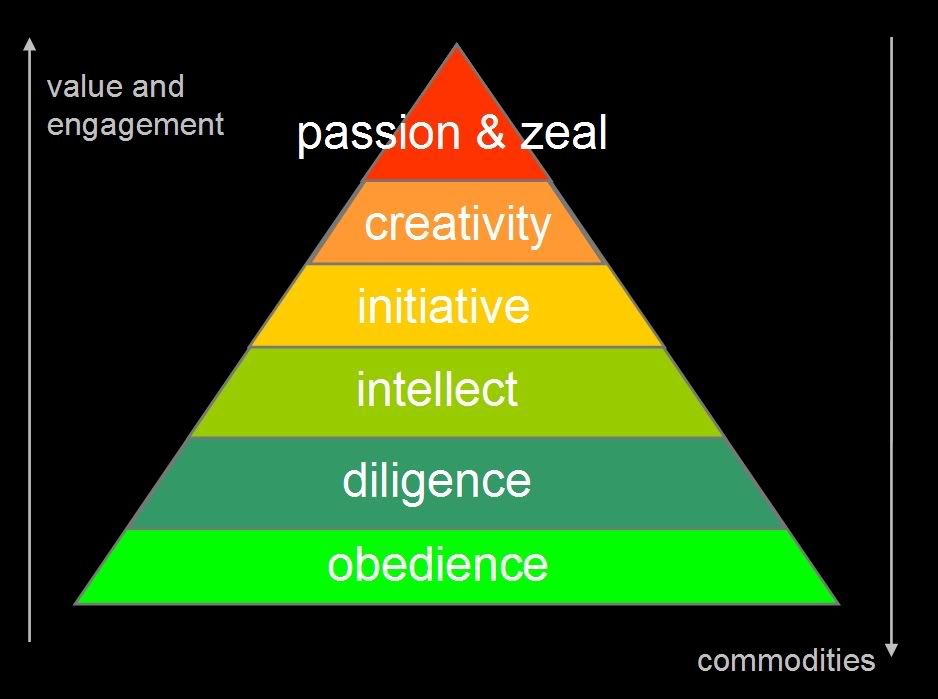
Gary Hamel's Pyramid of Human Capabilities

Love this!  Obviously the point of management 2.0 is to bring out the higher levels in employees.  More here.

Friday, April 8, 2011

Gary Hamel writes about the Bossless Organization in the Wall Street Journal


Here's the excerpt:
The boss-less organization: From bosses to mentor/investors
A hack from Tory Gattis

How do you move from a “command-and-control” leadership structure to one focused on motivating and mentoring? That’s the challenge Tory Gattis, founder of OpenTeams, takes on in his hack. Gattis argues that organizations need to abandon the boss-subordinate hierarchy in favor a new relationship that brings internal “mentor investors” together with intrapreneurial teams. Like Silicon Valley’s angel investors, mentors would provide funding, offer advice and make connections—but wouldn’t directly manage.

Key elements of the hack: Employees pitch ideas for investment—for a small project aimed at operational improvement or something grander. There is a large network of mentor investors who are able to provide funding and project teams are free to shop their ideas around. Investors can form syndicates to back bigger, riskier investments. Over time, successful investors and teams would command a larger share of resources.

In an organization built around Gattis’ hack, every idea would have the chance to compete on an equal footing and no single manager would have the power to kill a great idea. That would be a huge spur for innovation and proactive change.

Wednesday, February 23, 2011

Self-Management Institute features the Bossless Organization

Not sure how long it will last, but it's up now (and here in their archives).  Morning Star is a real company of substantial size that has no bosses and no hierarchy.  There's a lot of other good material there too, so check it out.

Wednesday, January 5, 2011

The problem of leadership and bureaucracy articulated

On the surface, this article titled "Solitude and Leadership" from a lecturer at West Point wouldn't seem to have a lot to do with the theme of this blog.  But it does one of the best jobs I've ever seen at articulating the core problem with bureaucratic hierarchies.  Overall it's one of the best articles I've read in years - and I read a lot of articles.  NYT columnist David Brooks gave it a best-of-2010 award.  Definitely read the whole thing, but here's a couple excerpts to get you interested:
"That’s really the great mystery about bureaucracies. Why is it so often that the best people are stuck in the middle and the people who are running things—the leaders—are the mediocrities? Because excellence isn’t usually what gets you up the greasy pole. What gets you up is a talent for maneuvering. Kissing up to the people above you, kicking down to the people below you. Pleasing your teachers, pleasing your superiors, picking a powerful mentor and riding his coattails until it’s time to stab him in the back. Jumping through hoops. Getting along by going along. Being whatever other people want you to be, so that it finally comes to seem that, like the manager of the Central Station, you have nothing inside you at all. Not taking stupid risks like trying to change how things are done or question why they’re done. Just keeping the routine going.

...environments where what is rewarded above all is conformity... I realized that this is a national problem. We have a crisis of leadership in this country, in every institution."
And that's why Management 2.0, Organization 2.0, the Bossless Organization, or whatever you want to call it is so critical to the future of not just our country, but all of human civilization.

Monday, December 20, 2010

Dan Pink TED Talk on the surprising science of motivation

Great talk on why incentives often backfire and the importance of intrinsic motivation with purpose, autonomy, and mastery.  He explicitly calls for a rethinking of how we practice management.

Tuesday, November 23, 2010

The Bossless Organization wins the M-Prize!

Way back in May, I submitted the Bossless Organization concept to the Management Innovation eXchange community as an entry in their M-Prize contest.  The community was founded by Gary Hamel - ranked by the Wall Street Journal as the world's most influential management thinker - to pioneer Management 2.0.  Last night I received notification that I was one of six winners out of hundreds of submissions:
I'm so pleased to inform you that you've won an M-Prize for the Hack you contributed to the MIX:  The Bossless Organization: From Bosses to Mentor Investors

We combed through hundreds of contributions from MIXers from around the world and from every kind of organization—looking for boldness, originality, thoroughness, and the ability to inspire and instruct in equal measure. We certainly found those qualities in your contribution!

The official announcement of the winners is tomorrow morning (10am EST). The McKinsey Quarterly will publish an article about the M-Prize and will send an alert to hundreds of thousands of subscribers. We'll celebrate you and your fellow winners on the MIX home page, M-Prize page and in a series of blog posts from me and Gary Hamel. You'll also receive recognition on the MIX and the Quarterly's Facebook and Twitter streams and in a variety of our partner's forums (from the Wall Street Journal to opensource.com). We'll keep you posted as these announcements go live. And, of course, you are now a lucky ticket holder for the 2011 World Innovation Forum.
Judges for the M-Prize included CEOs and thought leaders such as Harvard professor and former Medtronic CEO Bill George, W.L Gore's CEO Terri Kelly, Whole Foods' Founder and CEO John Mackey, "Future of Work" MIT professor Tom Malone, and venture capitalist Leighton Read.  I'd say that's quite a list of endorsements!

You can read an extended blog post about the contest and the winners here: "Announcing the M-Prize Winners: Audacity, Imagination, Experimentation"

I have to say I was surprised and stunned to receive such an honor.  It is an incredibly exciting development, and one that I hope acts as a spark to get more organizations to experiment with management 2.0 concepts, including the Bossless Organization.  If the concept is something of interest to you, please drop me a line (tgattis (at) openteams.com), most especially if you might consider trying it inside your own organization.

Update: The McKinsey Quarterly has published their article on the M-Prize winners here, including a sidebar on the Bossless Organization.

Update 2: Gary Hamel summarizes the Bossless Organization in the Wall Street Journal here.  See the second item.

Wednesday, October 20, 2010

SIDEARM Presentation to the Business Complexity Conference

I partnered up with Howard Park at ModelAnswers to submit a paper to the Business Complexity & The Global Leader Conference held this week at Suffolk University in Boston.  The paper is titled SIDEARM (Self-organizing for Innovation, Decisions, Engagement, Action, and Risk Mitigation), and it includes the concepts of horizontal and vertical compression (visual complex systems modeling and the Bossless Organization, respectively).  They accepted it and Howard was able to attend and present it today with this slick Prezi presentation, while I attended via Skype.  It was well-received and generated some good Q&A.  Here's the abstract:
The BP oil spill disaster has shown us all too vividly the catastrophic consequences of excessive organizational complexity and the potential risks to corporate longevity. This paper sets out a model for both the horizontal and vertical compression of organizations to simplify them for enhanced risk mitigation, with additional benefits for innovation, decision-making, employee engagement and action. Horizontal compression involves complex systems visualization, modeling, and simulation for cross-organizational integrated solutions, leading to better decision-making, action, and risk mitigation. We also propose vertical compression of the bureaucratic, command-and-control hierarchy into a flat, entrepreneurial, market-based, self-organizing Bossless Organization. This model is inspired by the Silicon Valley and open source ecosystems to improve innovation, employee engagement, and adaptation to the rapidly changing business environment. Bosses are replaced by non-controlling Mentor Investors—modeled on the angel investors of Silicon Valley—who then sponsor self-organizing, intrapreneurial project teams. Linus’ Law of the open source movement also enhances risk mitigation (and therefore corporate longevity): “Given enough eyeballs, all bugs are shallow.” The combined horizontal and vertical compression components of the SIDEARM model can provide a powerful and sustainable competitive advantage to any organization.
If you have any questions or would like to explore the SIDEARM model for your organization, please don't hesitate to comment here or contact Howard or myself (tgattis (at) openteams.com).

Friday, October 1, 2010

OpenTeams profiled in the Houston Chronicle

OpenTeams was profiled in the Business section of the Houston Chronicle this morning! The nonprofit K-12 education initiative mentioned is still in the early stages, but I'll post more on it here as it develops.  Very exciting potential.  In the meantime, if you might like to help or be involved, email me at tgattis (at) openteams.com.  Thanks.

Saturday, August 21, 2010

The End of Management

Wall Street Journal Deputy Managing Editor Alan Murray has an excellent essay in the paper today titled "The End of Management: Corporate bureaucracy is becoming obsolete. Why managers should act like venture capitalists."  It stunned me in its alignment with the Bossless Organization (aka Organization 2.0), all the way down to the venture capital model and entrepreneurial, ad-hoc teams of peers.

It starts by arguing that, if management of the corporate bureaucracy was the most important innovation of the 20th century (Drucker), changes in the 21st century are rapidly making it obsolete: globalization, accelerating innovation, relentless competition, rapidly changing markets - they simply can't adapt fast enough. That's half of the problem - the other half is rapidly dropping transaction costs reducing the need for large, bureaucratic corporations (a la Ronald Coase). Mass collaboration is now easily accessible and affordable via the Internet. He then moves on to what's next:
...the trends here are big and undeniable. Change is rapidly accelerating. Transaction costs are rapidly diminishing. And as a result, everything we learned in the last century about managing large corporations is in need of a serious rethink. We have both a need and an opportunity to devise a new form of economic organization, and a new science of management, that can deal with the breakneck realities of 21st century change.
...
The new model will have to be more like the marketplace, and less like corporations of the past. It will need to be flexible, agile, able to quickly adjust to market developments, and ruthless in reallocating resources to new opportunities.
...
This is the core of the innovator's dilemma. The big companies Mr. Christensen studied failed, not necessarily because they didn't see the coming innovations, but because they failed to adequately invest in those innovations. To avoid this problem, the people who control large pools of capital need to act more like venture capitalists, and less like corporate finance departments. They need to make lots of bets, not just a few big ones, and they need to be willing to cut their losses.

The resource allocation problem is one Google has tried to address with its "20%" policy. All engineers are allowed to spend 20% of their time working on Google-related projects other than those assigned to them.
...
In addition to resource allocation, there's the even bigger challenge of creating structures that motivate and inspire workers. There's plenty of evidence that most workers in today's complex organizations are simply not engaged in their work. Many are like Jim Halpert from "The Office," who in season one of the popular TV show declared: "This is just a job.…If this were my career, I'd have to throw myself in front of a train."

The new model will have to instill in workers the kind of drive and creativity and innovative spirit more commonly found among entrepreneurs. It will have to push power and decision-making down the organization as much as possible, rather than leave it concentrated at the top. Traditional bureaucratic structures will have to be replaced with something more like ad-hoc teams of peers, who come together to tackle individual projects, and then disband.
...
The new model will have to go further. New mechanisms will have to be created for harnessing the "wisdom of crowds." Feedback loops will need to be built that allow products and services to constantly evolve in response to new information. Change, innovation, adaptability, all have to become orders of the day.

Can the 20th-century corporation evolve into this new, 21st-century organization? It won't be easy. The "innovator's dilemma" applies to management, as well as technology. But the time has come to find out. The old methods won't last much longer.
Hear, hear!

Thursday, May 20, 2010

Designing the Bossless Organization: From Bosses to Mentor Investors

I was able to make this presentation at the Self-Management Institute Symposium last week in California.  It was well received and generated a lot of dialogue.  So this week I registered at the Management Innovation Exchange (MiX) community and submitted a condensed version as a 'hack'.  Let me know what you think, over there or over here (although voting/rating over there is appreciated).  Thanks.